About Naytra Kaushik, L.E.A.D. Research Fellow

Naytra Kaushik is a student at El Dorado High School interested in psychology and helping others in her community. She has experience in volunteering and supporting others in different ways, where she has developed strong communication, empathy, and teamwork skills.
As part of the LEAD program, Naytra is working on a project focused on reducing anxiety and depression among young women (ages 18–25) in Lubao, Philippines through a simple 8-week mental health program. This issue affects young women in areas with limited access to mental health support, making it important to provide accessible and easy-to-use resources.
Her project aims to offer regular mental health check-ins and a simple self-help guide to help participants better understand and manage their emotions. Donations will support materials and program implementation, helping to improve mental health and make support more accessible.
About My Research:
Improving Mental Health in Young Women
Hypothesis
Giving young women an 8-week mental health program—bi-weekly check-ins and a self-help guide—will decrease their anxiety and depression scores. I am comparing their scores before and after the program.
Among females (ages 18–25) residing in Lubao, Philippines, the implementation of a Low-Intensity Intervention—comprised of bi-weekly psychometric screening (PHQ-9/GAD-7) and the distribution of a CBT-based psychoeducational pamphlet—will result in a statistically significant reduction in GAD-7 and PHQ-9 symptom severity scores when comparing participants’ Pretest (Baseline) scores to their Posttest (Final) scores.
Outcomes
Mental Health (Primary): statistically significant reduction in anxiety (GAD-7) and depression (PHQ-9) symptom severity scores among young women, demonstrating an effective, accessible, and low-cost model for addressing untreated mental health issues due to cost and lack of access.
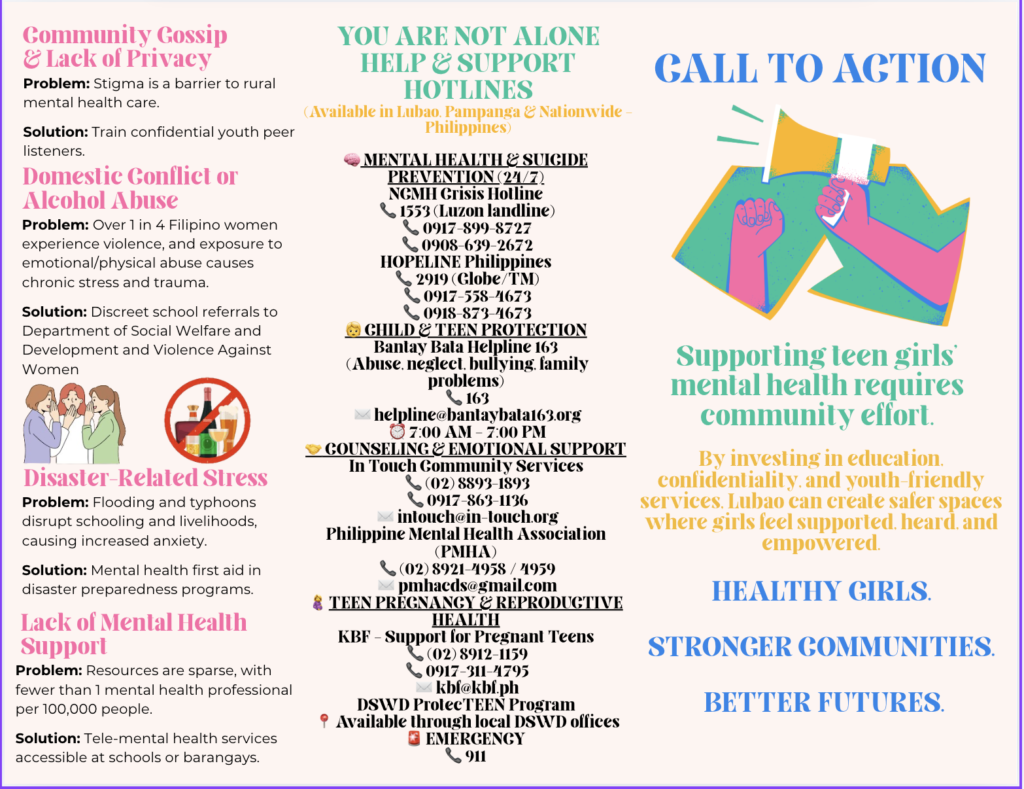
Education: The CBT-based psychoeducational pamphlet and bi-weekly screenings will increase mental health literacy, equipping participants with essential self-help coping strategies to regulate emotions and improve focus.
Social and Equality: By offering a confidential, low-stigma intervention to females aged 18–25, the project specifically addresses a vulnerable demographic and helps reduce the judgment and stigma associated with seeking psychological support in the community.
Economics: The Low-Intensity Intervention is a scalable, cost-effective, and sustainable public health approach that requires minimal resources compared to traditional, long-term psychotherapy or pharmaceutical interventions.
Legislation/Policy: The validated, statistically significant findings (p-value < 0.05) provide empirical evidence that can be used to advocate for local government funding and policy changes to support the long-term implementation of low-intensity mental health programs for youth.
Tri-fold Pamphlet Given to Young Women in Lubao